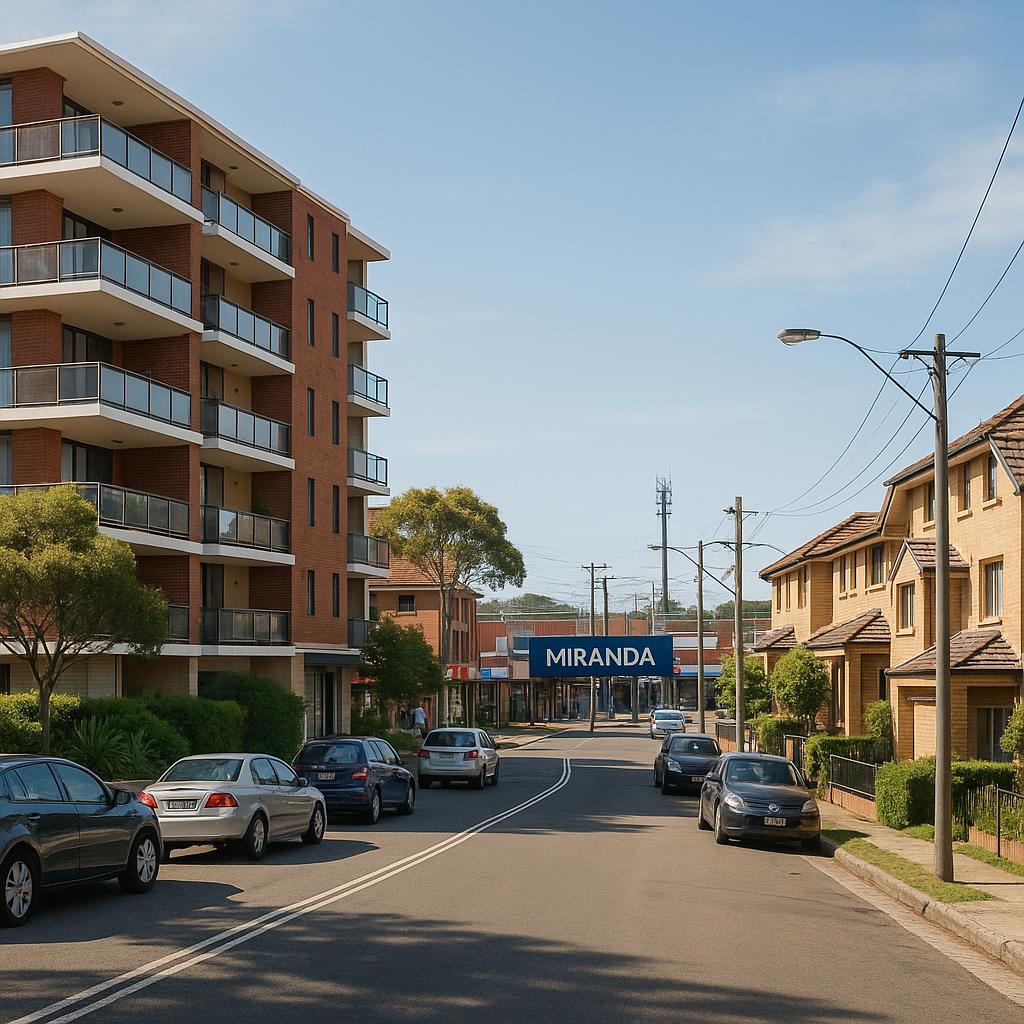
Quick Answer
Miranda suits buyers who want convenience first: strong everyday amenity, rail access, shopping, healthcare, and a central Sutherland Shire location. It is a practical suburb rather than a prestige play, which is exactly why it appeals to owner-occupiers, downsizers, and investors seeking broad, steady demand. The best opportunities usually come from matching the right property type to the right micro-location, because building quality, noise, parking, and walkability matter a lot here.
Key Takeaways
- Miranda is a convenience-led suburb with broad appeal for buyers who value daily practicality over lifestyle novelty.
- Demand is strongest for well-located apartments, functional townhouses, and the occasional well-kept freestanding home.
- Investors should focus on tenant fit, strata quality, parking, and access to transport and retail amenity.
- Street position matters more than many buyers expect; busy edges can trade convenience for noise and traffic exposure.
- Miranda often works best for people who want to stay connected to the Shire without sacrificing access to services.
Pros & Cons
Pros
- Central location with strong everyday convenience.
- Broad appeal across owner-occupiers and tenants.
- Good fit for low-friction, practical living.
Cons
- Busier and denser than quieter surrounding pockets.
- Apartment quality varies widely by building and era.
- Some locations feel more commercial than residential.
Market Overview
Miranda is a major service centre in the Sutherland Shire, and that role shapes the market. The suburb combines a strong retail core with established residential pockets, so buyers are often choosing between convenience, space, and quiet rather than simply choosing the “best” street.
The housing mix is varied: apartments, older walk-up units, townhouses, duplex-style dwellings, and some freestanding homes. That means the market is segmented by property type, building quality, parking, and proximity to the train and shopping precinct, not just by suburb name.
For buyers, the key lesson is that Miranda rewards careful micro-location analysis. A practical apartment near amenities can suit a commuter or downsizer, while a quieter residential pocket may appeal more to families wanting less foot traffic and a better sense of separation.
Buyer Demand
Demand is anchored by convenience. Miranda attracts buyers who want to shorten errands, commute without hassle, and keep everyday life simple. That creates a broad audience: first-home buyers looking for entry into the Shire, families seeking a workable base, downsizers wanting lower-maintenance living, and investors looking for stable tenant interest.
The strongest demand usually goes to properties that are easy to live in and easy to resell: good natural light, usable layouts, parking, storage, and a sensible distance from the busiest commercial edges. Buyers are not just paying for the postcode; they are paying for how well the property supports daily routines.
Rental Market
Miranda has rental appeal because it suits many tenant profiles: commuters, couples, small families, and renters who value access to shops, services, and transport. That breadth can help reduce vacancy stress when the property itself is well-presented and realistically priced for its type.
Apartments tend to suit singles and couples, while townhouses often appeal to long-term tenants needing more space and a more house-like feel. For investors, the best rentals are usually the ones that are easy to furnish, easy to maintain, and located where tenants can live without needing a car for every errand.
Lifestyle, Transport & Schools
Miranda’s lifestyle proposition is straightforward: it is a highly practical suburb where shopping, services, and daily essentials are close at hand. That makes it attractive to residents who want to spend less time travelling for basics and more time simply getting on with life.
Transport access is a major part of the appeal, especially for commuters who want rail connectivity into greater Sydney. Road access also supports local movement across the Shire. In a suburb like Miranda, transport convenience expands the buyer and tenant pool because it makes the area functional for a wider range of households.
Families also consider school access across the surrounding area, rather than only within the suburb boundary. The real decision point is whether the home supports the school-run, commute, and weekly errands without becoming logistically exhausting. Verify school zoning and current enrolment details through the NSW Department of Education before relying on assumptions.
Miranda (NSW) Suburb Profile
Official 2021 Census snapshot for the ABS Suburbs and Localities geography.
Age profile
Housing tenure
Occupied private dwellings by tenure type.
Salary & income profile
Median total income reported in the Census.
*Annual figures are weekly median × 52 estimates, not separate ABS annual medians.
Education & qualifications
Highest educational attainment, people aged 15+.
Employment status
People aged 15+ who reported being in the labour force.
Industry of employment
Top responses among employed people aged 15 years and over.
Occupation profile
Broad occupation groups among employed residents, including managers.
Property Type Guide
- Apartments: Best for first-home buyers, downsizers, and investors seeking entry into a central location. Check strata records, building age, ventilation, noise, parking, and storage.
- Townhouses: Useful for families and right-sizers who want more space without the upkeep of a full house. Inspect layout efficiency, privacy, access, and ongoing strata obligations.
- Houses: Scarcer and often more emotionally contested when they appear. Focus on block usability, renovation scope, parking, and future extension potential.
- Older stock: Can offer better room sizes or positioning, but may carry higher maintenance risk and less efficient layouts.
- Newer stock: Often attractive for presentation and lower immediate maintenance, but compare construction quality, density, and long-term usability carefully.
Risks & Watch-Outs
- Busy roads, retail edges, and high-traffic streets can reduce amenity even when the address is highly convenient.
- Apartment quality varies sharply, so a strong location does not automatically mean a strong asset.
- Parking, storage, and noise control matter more here than some buyers expect, especially for long-term liveability.
- Strata costs, special levies, and building maintenance history can materially change the holding experience.
- Buying for suburb reputation alone is risky; the best result usually comes from street-by-street and building-by-building assessment.
Nearby Suburbs to Compare
- Gordon NSW Property Market Guide: Buyers & Investors
- Kogarah NSW Property Market Guide: Buyers & Investors
- Hurstville NSW Property Market Guide: Buyers & Investors
- Caringbah
- Gymea
- Cronulla
FAQ
Is Miranda good for first-home buyers?
Yes, particularly if you are comfortable with apartment or townhouse living. The suburb offers practical access to transport and services, which can make entry-level ownership more manageable. The key is to compare building quality, parking, and strata costs carefully before committing.
Is Miranda a good suburb for investors?
It can be, because tenant demand is broad and practical rather than speculative. Investors should focus on properties that are easy to lease and maintain, with layouts that suit real households. A well-located, well-presented asset is more important than chasing novelty.
What type of property is best in Miranda?
That depends on strategy. Apartments may suit affordability and simplicity, townhouses often balance space with lower maintenance, and houses are scarcer but can have stronger family appeal. The right choice depends on liveability, holding costs, and the likely future buyer pool.
Is Miranda suitable for families?
Yes, especially for families who value convenience and access to services. The trade-off is that some parts of the suburb are busier than quieter residential areas nearby. Families should assess school logistics, parking, storage, and the feel of the immediate street.
What should buyers watch out for in Miranda?
The main issues are traffic exposure, building quality, strata costs, noise, and whether the property actually feels residential rather than overly commercial. Inspect at different times of day and compare several streets or buildings before deciding what represents good value.
Conclusion
Miranda is a practical, high-utility suburb that suits buyers and investors who prioritise convenience, transport access, and everyday livability. It is rarely about hype. The strongest outcomes usually come from careful micro-location selection, a realistic understanding of property type trade-offs, and a close look at building quality and total holding costs.
Sources & how to verify
- Check current sales and rental listings on Domain to confirm how Miranda properties are being priced and presented right now.
- Use realestate.com.au to compare available stock, property types, and listing depth across Miranda and nearby suburbs.
- Review the ABS for suburb and region-level demographic context, but avoid using it as a substitute for current market evidence.
- Confirm train and bus servicing through Transport for NSW, especially if commute convenience is central to your buying decision.
- Check school intake areas and official school details via the NSW School Finder rather than relying on general reputation.
- Review planning, zoning, and development controls through the NSW Planning Portal to understand redevelopment risk and local approvals context.
- Look at the Sutherland Shire Council website for local works, community assets, and planning updates that may affect livability.
- Suggested internal links: Miranda has genuine comparison value with Gymea-style quieter living, Caringbah convenience, and Cronulla lifestyle trade-offs, but only use these if you are building a local comparison cluster.