Quick Answer
Cranbourne is a practical outer south-east Melbourne suburb that suits buyers who want more space, a family-friendly environment, and a more attainable entry point than many middle-ring areas. For investors, it can make sense where the property is well-located, low-maintenance, and close to everyday amenity. The key is to assess the exact pocket carefully, because older streets, newer estates, and transport-adjacent areas can perform quite differently.
Key Takeaways
- Cranbourne generally offers a more accessible way into Melbourne’s south-east growth corridor.
- The suburb appeals to families, first-home buyers, and investors seeking broad tenant demand.
- Location matters: proximity to transport, schools, and shopping can materially affect liveability and resale.
- Housing stock is mixed, so buyers should compare older homes, newer estates, and low-maintenance options.
- Long-term decisions should weigh commute time, upkeep costs, and the specific streetscape of each pocket.
Pros & Cons
Pros
- More accessible price point than many inner and middle-ring Melbourne suburbs
- Family-oriented environment with parks, schools, and everyday services
- Broad housing choice: older homes, renovated dwellings, townhouses, and newer estates
Cons
- Commute times can be longer than buyers expect, especially during peak periods
- Estate quality and streetscape can vary significantly from one pocket to another
- Some areas can feel car-dependent if they sit away from transport and retail nodes
Market Overview
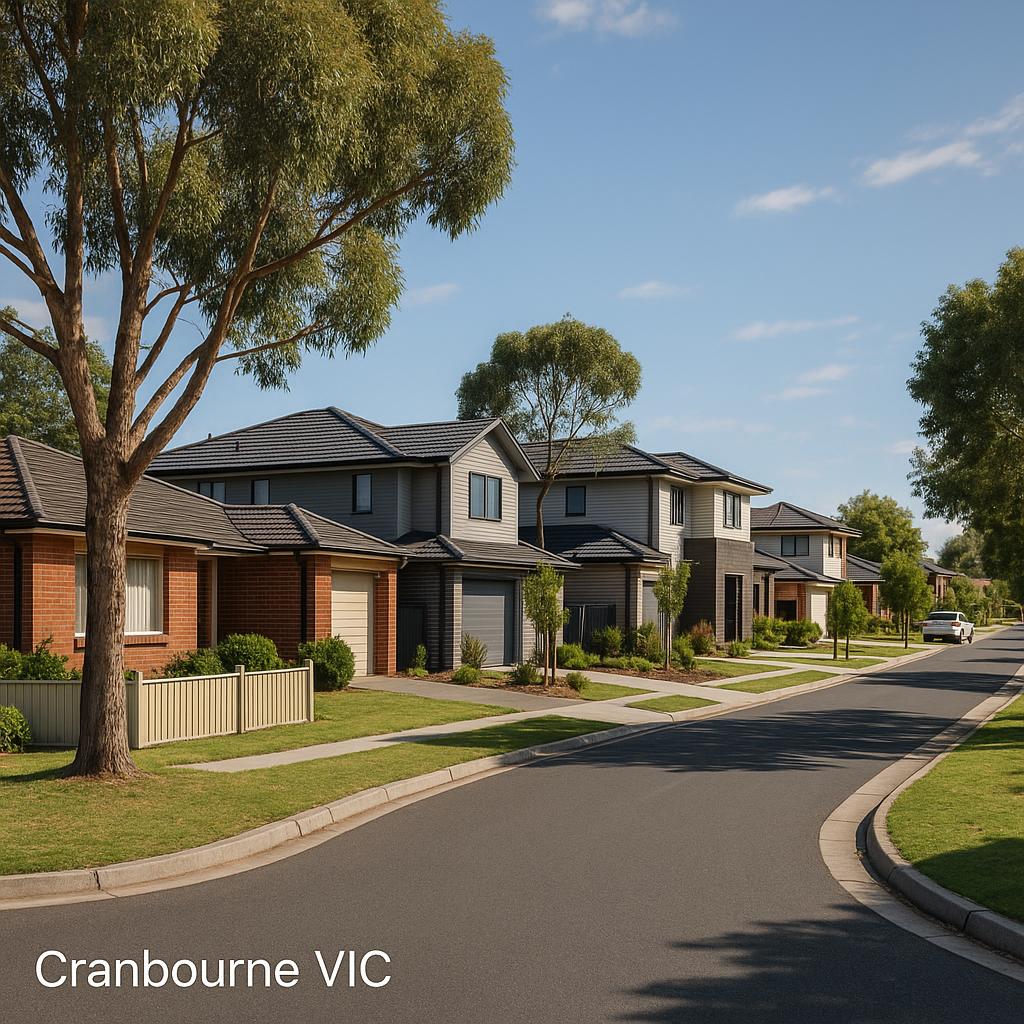
Cranbourne sits in Melbourne’s outer south-east and functions more as a residential hub than a single uniform suburb. That matters for buyers, because the market can behave differently depending on whether you are looking at older established streets, newer estate-style pockets, or areas with better access to transport and shopping.
The suburb draws attention for a simple reason: it offers a practical value proposition. Buyers priced out of more established south-eastern suburbs often look here for a larger home, a yard, or a lower-maintenance modern build. Investors also watch it because the demand base is broad and generally includes families, first-home renters, and long-term tenants who prioritise space and convenience.
In decision-making terms, Cranbourne is best assessed as a collection of micro-markets. A neat home near services can present very differently to a similar property deeper in a newer estate. For that reason, the strongest buyers compare street quality, layout, parking, and day-to-day convenience rather than relying on the suburb name alone.
Buyer Demand
Demand is usually driven by a mix of first-home buyers, young families, and investors. That combination can be useful, because it supports both owner-occupier appeal and rental liquidity. It also means good homes can still attract strong interest even when the broader market softens.
Buyers in Cranbourne often value practical features over prestige. Land size, functional floorplans, secure parking, and low-maintenance presentation tend to matter more than cosmetic detail. For many households, the real question is whether the property supports the way they live, commute, and grow into the area over time.
Rental Market
Cranbourne can appeal to renters who want family-sized accommodation without moving too far into higher-cost suburbs. That tends to create a tenant pool made up of households seeking multiple bedrooms, backyard space, and access to everyday amenity.
For investors, the better rental performers are usually the properties that are easy to maintain and easy to occupy: tidy homes, sensible layouts, off-street parking, and good access to transport or retail. The key is not to chase assumptions about rent, but to verify current comparable listings and recent leased results before making a decision.
Lifestyle, Transport & Schools
Daily life in Cranbourne is generally practical rather than flashy. The suburb suits buyers who want a suburban routine with parks, sport, shopping, and community services close enough to make family life manageable. That everyday convenience is often a major reason people stay once they move in.
Transport access is an important value driver here. Rail and bus connectivity, plus road links across the south-east, can shape both commute quality and rental appeal. Buyers should test the route they actually expect to use, because map distance alone does not capture peak-hour friction.
Schools and childcare are also central to the buying decision for families. Rather than focusing on rankings, buyers should check convenience, catchment implications, walking routes, and whether the local network suits long-term family planning. A property that works for school drop-off and after-school routines can be more valuable than one that simply looks good online.
Cranbourne Suburb Profile
Official 2021 Census snapshot for the ABS Suburbs and Localities geography.
Age profile
Housing tenure
Occupied private dwellings by tenure type.
Salary & income profile
Median total income reported in the Census.
*Annual figures are weekly median × 52 estimates, not separate ABS annual medians.
Education & qualifications
Highest educational attainment, people aged 15+.
Employment status
People aged 15+ who reported being in the labour force.
Industry of employment
Top responses among employed people aged 15 years and over.
Occupation profile
Broad occupation groups among employed residents, including managers.
Property Type Guide
- Established family homes: Often suit owner-occupiers and renovators who want more land, more flexibility, and potential improvement upside.
- Newer estate homes: Usually appeal to families and investors wanting modern layouts, cleaner presentation, and lower day-one maintenance.
- Townhouses and smaller dwellings: Can suit entry-level buyers, downsizers, and investors prioritising reduced upkeep and easier management.
- Renovation candidates: Worth considering only if the fundamentals are strong, because cosmetic upgrades are easier to change than location or land.
Risks & Watch-Outs
- Do not treat Cranbourne as one market; pocket-by-pocket differences can change buyer demand and resale confidence.
- Commute times can be longer than expected, so test peak-hour travel before assuming a property is suitably located.
- Newer estates may look similar on paper but differ in street appeal, walkability, and long-term convenience.
- Older homes can offer better land value but may bring higher maintenance, drainage, or renovation costs.
- For investors, buying purely on appearance can lead to weaker tenant appeal if parking, layout, or access is poor.
Nearby Suburbs to Compare
- Cranbourne North
- Cranbourne West
- Clyde North
- Berwick
- Narre Warren
FAQ
Is Cranbourne a good suburb for first-home buyers?
Often, yes, because it can provide a more attainable entry point than many inner and middle-ring Melbourne suburbs. First-home buyers should still compare pockets carefully, especially for commute quality, street appeal, and the true cost of future maintenance.
Is Cranbourne good for investors?
It can be, particularly when the property is easy to lease and well placed for everyday convenience. Investors should focus on tenant demand, layout, parking, presentation, and location near transport or services rather than assuming any one pocket will perform the same way.
What type of property should I buy in Cranbourne?
The right choice depends on your strategy. Families often prefer larger homes or newer estates, while investors may favour low-maintenance dwellings with broad tenant appeal. Compare holding costs, renovation needs, and the likely future buyer or tenant pool.
How does Cranbourne compare with nearby suburbs?
That depends on what you value most. Compare it with Cranbourne North, Cranbourne West, Clyde North, Berwick, and Narre Warren to judge trade-offs in affordability, convenience, housing age, and the style of community you want.
What should I inspect before buying?
Check the street, parking, drainage, layout, natural light, storage, and general upkeep, not just the façade. Also verify transport access, school convenience, and any planning or estate restrictions that could affect future use or resale.
Conclusion
Cranbourne is a sensible suburb to research if you want a family-oriented location with broad appeal and a more accessible entry point than many established Melbourne areas. The best outcomes usually come from buying the right pocket and the right property type, not just buying in the suburb broadly. Compare carefully, inspect thoroughly, and verify current local conditions before acting.
Sources & how to verify
- Check current sold prices and active listings on Domain so you are comparing recent evidence rather than relying on outdated estimates.
- Review recent sale results and suburb-level listing patterns on realestate.com.au to understand how similar homes are being marketed and absorbed.
- Use the Australian Bureau of Statistics to check broader demographic trends and household composition without guessing at local figures.
- Confirm rail, bus, and corridor updates through Public Transport Victoria so you can assess commute options using current service information.
- Look up planning controls and local planning context on the Victorian Planning Authority website before assuming future development outcomes.
- Check school zones, enrolment guidance, and local school details through the Find My School tool rather than relying on informal advice.
- Visit the City of Casey website for local council planning, community facilities, and infrastructure updates relevant to day-to-day livability.
- Inspect the street at different times of day and in different weather conditions, because traffic, noise, drainage, and neighbourhood activity are often only obvious on site.
Internal link suggestions: Berwick VIC Property Market Guide: Buyers & Investors, Narre Warren VIC Property Market Guide: Buyers & Investors, Cranbourne West VIC Property Market Guide: Buyers & Investors, Cranbourne North VIC Property Market Guide: Buyers & Investors